Navigating modern digital conversations often feels like learning a second language, especially when you encounter cryptic abbreviations like WYM.
If you have ever stared at a message wondering what does wym mean in text, you are certainly not alone. This common acronym is a staple of instant messaging, serving as a quick way to ask for clarification without typing out a full sentence.
Understanding these shorthand terms is essential for keeping up with the rapid pace of social media and casual texting. By breaking down the origins, nuances, and social contexts of this expression, you will gain the clarity needed to communicate more effectively in your daily online interactions.
Meaning and Definition of what does wym mean in text

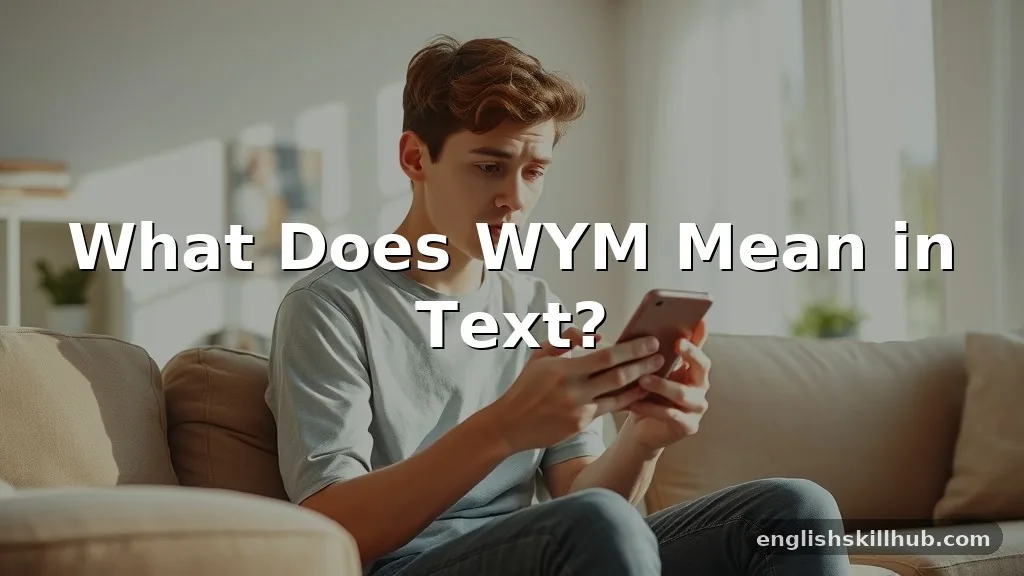
At its core, the acronym WYM stands for the phrase, “what you mean?” or “what do you mean?” It functions as a direct, inquiry-based shorthand used primarily in digital communication.
When someone sends this to you, they are effectively hitting the pause button on the conversation to ask for context or elaboration regarding your previous statement. It is a tool for alignment, helping to bridge the gap when a message might be ambiguous, confusing, or lacking necessary detail.
Unlike more formal requests for information, using this acronym implies a casual, conversational tone. It is rarely used in professional emails or academic writing, as its brevity can be perceived as overly informal or even blunt depending on the relationship between the two parties. However, in the context of a quick chat, it serves its purpose efficiently.
It saves the sender from having to type out four distinct words, allowing the flow of the conversation to remain snappy and immediate. If you are ever confused by a statement, using this term is a standard way to signal that you need further explanation before moving forward.
Background and Origin
The rise of acronyms like WYM is inextricably linked to the evolution of mobile technology. As texting became the primary mode of communication in the early 2000s, users were constrained by character limits and the tedious nature of T9 predictive text or early QWERTY keyboards.
Efficiency became the priority, and the English language began to undergo a rapid transformation through the adoption of text-speak. While it is difficult to pinpoint the exact moment this specific acronym was coined, it gained widespread prominence alongside other staples like LOL, BRB, and BTW.
As platforms transitioned from SMS to instant messaging apps, the need for these shortcuts did not vanish; instead, it evolved.
The cultural shift toward brevity in digital spaces solidified these terms as part of a shared digital vocabulary. Today, even with modern smartphones that offer full keyboards and autocorrect, the habit of using shorthand remains a deeply ingrained feature of online culture.
It represents a stylistic choice rather than a necessity, signaling that the user is comfortable with the informal, fast-paced nature of digital discourse. This evolution reflects how language naturally adapts to the medium through which it is transmitted, prioritizing speed and social cues over rigid grammatical standards.
Usage in Different Contexts
The way you use this acronym changes significantly depending on where you are typing and who you are talking to. In casual texting between friends, it is a neutral tool for requesting information.
It feels light and conversational, much like a verbal “huh?” or “come again?” It does not typically carry a negative tone unless the context of the conversation is already heated or confrontational.
In contrast, social media comments often use this term to challenge a statement. If someone posts an opinion that others find confusing or controversial, you might see a string of comments asking for clarity.
If you are communicating in a professional field, however, it is generally best to avoid this acronym entirely. Using it in a workplace chat, such as Slack or Microsoft Teams, might be acceptable if you have a very close rapport with a colleague, but it is safer to stick to full sentences to maintain a professional standard.
- Casual texting: Used to clarify a misunderstood point or ask for more context.
- Social media: Often used to question a public statement or express confusion.
- Professional settings: Generally discouraged; full sentences are preferred for clarity.
- Dating apps: Used to gauge interest or clarify flirtatious intent.
Specific Nuances in WhatsApp, Instagram, and TikTok
Different platforms foster unique communication styles, and the interpretation of this acronym shifts to match the environment. On WhatsApp, where conversations are usually private and one-on-one, the term feels intimate and conversational.
It is a natural part of a back-and-forth dialogue between people who know each other well. Because WhatsApp is the primary hub for many personal relationships, the usage here is almost always functional rather than aggressive.
On Instagram and TikTok, the dynamic changes. These are public-facing platforms where comments are visible to a wider audience. When you see this term in a comment section, it is often used as a rhetorical device.
It might be a way of calling out a creator for saying something that doesn’t make sense, or it could be a way for a follower to engage with a post that sparked curiosity.
On TikTok specifically, the rapid-fire nature of video content means that viewers often use shorthand to comment quickly before moving on to the next video. The brevity of the term fits perfectly with the short, punchy nature of video-based social media, where long-form explanation is often impractical.
Analysis in Technical Fields
While the term is firmly rooted in social slang, one might wonder if it has any relevance in technical fields. In specialized domains such as physics, medicine, or aviation, clarity is paramount, and ambiguous acronyms are generally avoided to prevent errors.
You will not find this term in a medical chart, a pilot’s flight manual, or a scientific paper. These fields rely on standardized, internationally recognized terminology to ensure safety and precision.
If someone were to use this acronym in a technical or high-stakes environment, it would likely be viewed as unprofessional or potentially hazardous.
The International Civil Aviation Organization provides strict guidelines on standardized language to avoid the exact confusion that casual shorthand often creates. Therefore, while this term is a king of the casual text, it has virtually no place in technical or formal operational documentation.
Common Misconceptions
There is a common belief that using shorthand like this reflects a lack of intelligence or a decline in language proficiency. This is a misconception.
Linguists often argue that the ability to adapt one’s language to the medium—using shorthand in a text and formal grammar in an essay—is actually a sign of sophisticated communication skills. It demonstrates an awareness of social context and the ability to choose the right tools for the job.
Another misconception is that the term is always aggressive. While it can be used to challenge someone, it is just as often used to express genuine confusion. If you use it with a question mark, it is clearly an inquiry.
Without a question mark, or when combined with other aggressive emojis, it can take on a more confrontational tone. The meaning is highly dependent on the “voice” of the text, which is difficult to convey without physical cues like tone of voice or body language.
Misinterpreting this is a classic issue in digital communication, often referred to as the “online disinhibition effect,” where we assume the worst-case scenario in a text-based message.
Similar Terms and Alternatives
The digital landscape is crowded with acronyms that perform similar functions. Knowing these alternatives can help you vary your language and avoid repetition. Depending on the level of formality or the specific nuance you wish to convey, you might choose one of these options instead.
| Acronym | Full Meaning | Best Used When |
|---|---|---|
| WDYM | What do you mean? | Direct questioning of a statement |
| ELI5 | Explain like I’m five | Requesting a simple explanation |
| IDK | I don’t know | Signaling confusion or lack of info |
| PLZ ELAB | Please elaborate | More formal request for detail |
Each of these serves a slightly different social function. While they all aim to clear up confusion, the “vibe” of each is distinct.
Using “ELI5,” for example, carries a playful, humble tone, whereas “Please elaborate” is significantly more formal. Knowing the difference allows you to tailor your response to the specific person you are messaging.
How to Appropriately Respond
Responding to a request for clarification requires a balance of patience and brevity. If someone asks you this, it is a cue that your previous message wasn’t clear. The best approach is to rephrase your point rather than simply repeating it.
If you said something that was meant to be a joke but was taken seriously, clarify that intent. If you were being vague, provide the specific detail that was missing.
Avoid getting defensive. It is easy to feel as though you are being interrogated, but remember that text lacks the nuance of face-to-face conversation. Assuming the other person is acting in good faith makes the exchange much smoother.
A simple, “Sorry, I meant that [your point here]” is usually sufficient. Keep it brief and focused on the facts, and you will likely find that the conversation gets back on track immediately.
Differences Between Similar-Sounding Words
It is easy to confuse similar-sounding acronyms, especially when they are used in rapid-fire text exchanges. For example, WYM (what you mean) is often confused with WYN (which is sometimes used for “why not,” though less commonly). The context is usually the only way to distinguish them.
If someone asks a question, they are likely looking for information. If they are responding to a suggestion, they are likely expressing an opinion.
Another common point of confusion is the difference between “WYM” and “WDYM.” In practice, they are interchangeable. Both ask for clarification.
However, “WDYM” is slightly more common because it follows the standard grammatical structure of the question “What do you mean?” more closely. Over time, these terms have become synonymous in the minds of most users, and the distinction between them is negligible.
Relevance in Modern Online Conversations and Dating Apps
In the world of dating apps, communication is everything. When you are getting to know someone through a screen, misunderstandings are frequent.
Using this acronym in a dating context can be a great way to show that you are actively listening. It shows that you care enough about what the other person is saying to make sure you understand it correctly.
However, in dating, tone is even more critical. If you are constantly asking “what do you mean?” it can start to feel like you are being difficult or overly critical of the other person’s communication style. Use it sparingly.
If you find yourself confused by a match’s messages repeatedly, it might be a sign that your communication styles are not aligned. Use the acronym to bridge the gap initially, but if the confusion persists, it may be time to move the conversation to a voice call or a face-to-face meeting where tone and inflection can clear things up naturally.
Digital shorthand is a permanent fixture of our daily lives, and the ability to interpret these cues is a key component of modern social intelligence.
whether you are chatting with friends, engaging on social media, or navigating the complexities of dating apps. These abbreviations are not just lazy shortcuts; they are efficient tools that allow us to maintain connection and clarity in a fast-paced environment.
As you continue to participate in online communities, keep in mind that the goal of any communication—be it through formal prose or quick, shorthand messages—is mutual understanding. Embracing these tools while maintaining a clear, patient approach to your conversations will serve you well in all your digital interactions.
FAQs
1. What does WYM mean in text?
WYM usually means “What You Mean?” or “What do you mean?” It is commonly used in texting and online conversations when someone wants clarification.
2. What does WYM mean from a girl?
If a girl texts “WYM,” she usually means “What do you mean?” The exact tone depends on the conversation and what was said before it.
3. What does WYM mean from a guy?
When a guy uses WYM, he is usually asking you to explain or clarify something you said.
4. Is WYM rude in texting?
Not necessarily. WYM can sound casual or slightly direct, but it is not automatically rude. The tone depends on the context.
5. Can WYM mean something different?
Yes. In some contexts, abbreviations can have different meanings. However, in everyday texting, WYM most commonly means “What do you mean?”
6. How should I reply to WYM?
You can simply explain what you meant. For example, if someone says “WYM?”, you could reply, “I mean that we should talk later.”
Conclusion
Understanding what does WYM mean in text is simple. WYM is a common texting abbreviation that usually means “What do you mean?” People use it when they need clarification or want someone to explain a message.
While WYM is generally casual, its tone can change depending on the conversation. If you receive WYM, the easiest response is to explain your meaning clearly. Knowing common abbreviations like WYM can make texting and online conversations easier to understand.